
/mə/
Translation
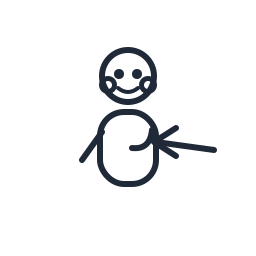
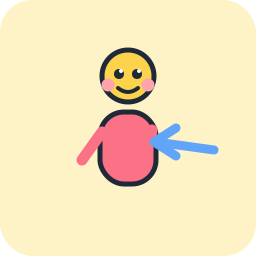
me, to me, myself (first-person singular object pronoun)
Word origin
From Latin me, the accusative and ablative of the first-person pronoun ego.
- Origin
- Latin
- Root
- me
- English cognates
- me
Examples
.
I miss you a lot.
l'.
He always asks me to help him.
.
She looks at me without saying anything.
, ' ?
Can you pass me the salt, please?
.
It seems to me we have already met.
Me est le pronom personnel de la premiere personne du singulier en position objet (direct ou indirect) et en position reflechie. Il se place immediatement avant le verbe conjugue : il me voit (COD), il me parle (COI), je me leve (reflechi). Devant une voyelle ou un h muet, me s'elide en m' : il m'appelle, je m'habille.
La distinction entre me COD et me COI n'est pas visible a la forme, mais elle influe sur l'accord du participe passe au passe compose avec avoir : elle m'a vu(e) (COD, accord) vs elle m'a parle (COI, pas d'accord). Cet accord n'est souvent plus prononce a l'oral, mais reste obligatoire a l'ecrit soutenu.
Where this fits
Used in
Stories
(5)Grammar articles
(54)French Adjective Position: Default, BAGS, and the Meaning Shifts
French Advanced Grammar (C1-C2): The Constructions That Sound Native
Comparing French Adverbs: plus vite, le mieux, and the Irregulars
French Adverbs of Manner: Forming -ment Adverbs
Avoiding the Passive in French: on, se and the Active Recast
avoir or être: Choosing the French Auxiliary in the Passé Composé
French Grammar Cheatsheet: The Essentials, One Page
French Comparatives: plus, moins, aussi and the Three Irregulars
French Conditionnel: Polite Requests, Hypothetical 'Would', and the Same Irregular Stems as the Future
The French Conditional Perfect: j'aurais fait, elle serait venue
Conjugating French -er Verbs in the Present Tense
Conjugating French -ir Verbs in the Present Tense
Conjugating French -re Verbs in the Present Tense
French Verb Conjugation: The Complete Rules with Examples
How to Say Therefore, So, Thus and Hence in French
How to Say However, Although, Even Though and Despite in French
French Demonstrative Pronouns: celui, celle, ceux, celles
Reported Speech in French: Tense Backshift (dit que, a dit que)
dont in Depth: The French de Relative Pronoun
Faire causatif: Having Things Done in French
The French Future Perfect: futur antérieur
quand + Future: The Tense English Refuses
French Greetings and Survival Phrases: Say Something Today
French Imparfait: One Stem, One Set of Endings, One Irregular
French Imperative: tu, nous, vous Commands and the Three Irregulars
French Impersonal Verbs: il y a, il faut, il fait and the Dummy Subject 'il'
Infinitive or Subjunctive: The French Same-Subject Rule
French Intermediate Grammar (B1-B2): The Things That Stop You at the Plateau
French Negation Beyond pas: ne... que, ni... ni, aucun
French Object Pronouns: me, te, le, la, lui, nous, vous, leur and the Preverbal Position
French Partitives and 'de': du, de la, des and the Negation Rule
French Passé Composé: avoir or être + Past Participle and the MRS VANDERTRAMP Set
Sequencing French Past Tenses: Passé Composé, Imparfait and Plus-que-parfait Together
laisser, voir and entendre + Infinitive in French
The French Pluperfect (le plus-que-parfait): The Past Before the Past
French Possessive Pronouns: le mien, le tien, le sien, le nôtre, le vôtre, le leur
French Possessives: mon, ma, mes and the mon-Before-Vowel Trap
French Pronouns Y and EN: there, some, of it, of them
French Reflexive Verbs: se laver, se lever, s'appeler and the Singular Pronouns
j'aurais dû, tu aurais pu: French Regrets and Reproaches
French Relative Pronouns After a Preposition: lequel, auquel, duquel
French Relative Pronouns: qui, que, dont, où and How to Glue Clauses Together
Reported Questions and Commands in French
French si Clauses: The Three Types of Conditional Sentence
French Stressed Pronouns: moi, toi, lui, elle, nous, vous, eux, elles
French Subject Pronouns: je, tu, il, nous, vous, ils and the on That Replaced nous
The French Subjunctive After Doubt, Emotion and Opinion
The French Subjunctive After Superlatives and Exclusives
The French Subjunctive in Relative Clauses
The French Past Subjunctive: subjonctif passé
Subjunctive or Indicative: How to Choose in French
French Verbs with à, de or Nothing Before an Infinitive
The French Passive Voice (la voix passive)
French Word Order: SVO, the Object Pronoun Inversion, and Six Rules That Cover 90% of Sentences
Add to review queue
Track this word in your spaced-repetition queue and be tested on it at the right interval.
Go to my review queueFrench · Free printables
me: worksheet, infographic and listicle
Free printable study downloads for the French word "me" (me, to me, myself (first-person singular object pronoun)): a worksheet with the answer key built in, an infographic, and a sentence listicle. Open any one to view, print or save.
Free for members
The printable worksheets, infographics and PDFs are free with an account. Start a free week and download as many as you like.
Start your free weekThis word is part of lesson 1.